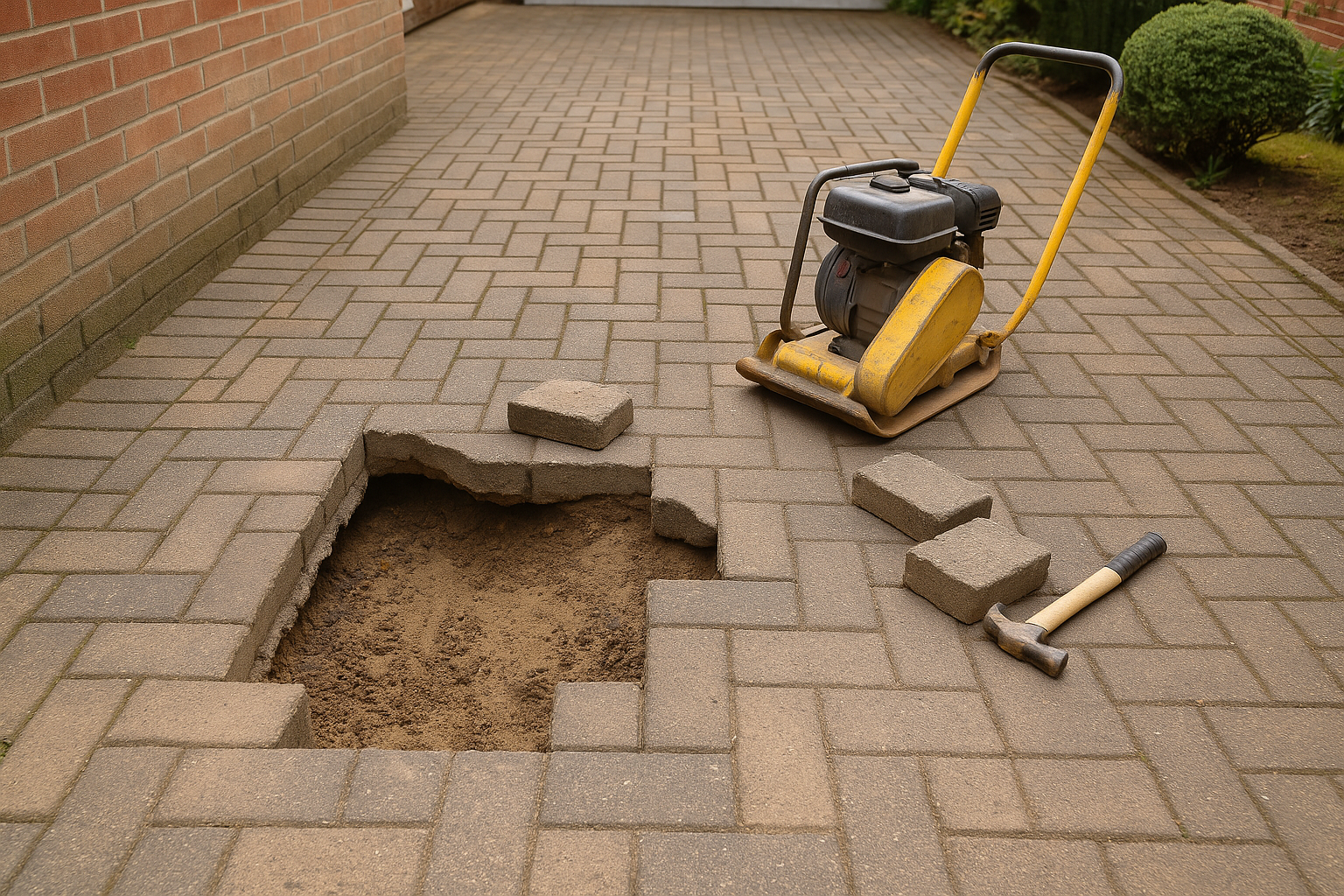
If you’ve noticed uneven patches, cracks, or dips forming across your driveway, you’re not alone. A sinking driveway is a common problem faced by homeowners — especially in areas with changing weather conditions or older installations. While it might start as a small dip or puddle after rain, over time it can turn into a safety hazard and an eyesore that drags down your home’s kerb appeal.
At Essex Elite Paving, we’ve helped hundreds of clients diagnose and fix sinking driveways across Essex. The good news? Most of the time, the problem can be traced back to a few common causes — and with the right approach, it’s completely repairable. In this post, we’ll explore the five main reasons your driveway might be sinking, what’s happening beneath the surface, and the best ways to fix it for good.
1. Poor Soil Compaction
One of the most frequent causes of a sinking driveway is poor soil compaction. When a driveway is installed, the ground beneath (called the subgrade) needs to be compacted to create a stable base. If this isn’t done correctly — or if it’s skipped entirely — the soil will settle over time, causing the driveway to dip or sink unevenly.
- Why it happens:
Many builders underestimate the importance of proper groundwork, especially if they’re rushing a job or trying to cut costs. Soft, loose, or damp soil is particularly vulnerable and can compact naturally under the weight of vehicles, creating those uneven dips. - How to fix it:
To correct poor compaction, the affected sections must be excavated down to the sub-base. Once exposed, the area should be filled with high-quality hardcore material and compacted in layers using a mechanical plate compactor or roller. Only once a stable base is achieved should new paving or concrete be installed.
For new driveways, professional installers like Essex Elite Paving always use MOT Type 1 or similar aggregate compacted in stages, ensuring a stable, long-lasting foundation that won’t move under pressure.
2. Drainage Problems
Water is one of the biggest threats to your driveway’s structure. If water isn’t draining correctly, it can seep beneath the surface and slowly wash away the supporting soil, leaving behind hollow voids that cause sinking.
- Why it happens:
Over time, blocked gutters, poorly placed downpipes, or a lack of surface drainage can let rainwater pool around the edges of your driveway. In clay soils, this becomes worse because trapped water has nowhere to go — softening the base and increasing the risk of collapse. - How to fix it:
Start by identifying where the water is coming from. Look for signs of pooling or staining after rainfall. Installing French drains, linear channel drains, or soakaways can help redirect water away from the surface.
At Essex Elite Paving, we design every installation with proper falls and gradients — meaning the driveway subtly slopes in the right direction so water naturally runs off instead of seeping below. This is one of the simplest yet most effective ways to prevent erosion and future subsidence.
3. Tree Root Growth
Trees add beauty and shade to your property, but their roots can quietly wreak havoc on your driveway. As roots grow, they push against the soil beneath the surface, displacing compacted ground and lifting or cracking the paving above. On the other hand, when tree roots die or rot, they can leave behind voids that cause the driveway to sink.
- Why it happens:
Roots naturally seek out moisture, often travelling far beyond the visible canopy of the tree. If your driveway is close to mature trees, it’s likely that the roots have extended underneath. - How to fix it:
An arborist can assess which roots are causing the problem. The solution might include installing a root barrier to prevent further intrusion, or removing certain roots if it won’t harm the tree. After the area is stabilised, Essex Elite Paving can rebuild the base with reinforced materials that allow for natural ground movement without cracking the surface.
A key tip for homeowners: when designing new driveways near trees, always allow sufficient distance or incorporate a root-safe base system to avoid future disruption.
4. Substandard Construction Materials
Not all paving materials are created equal. Using the wrong materials or cutting corners during installation can lead to early sinking, cracking, or crumbling.
- Why it happens:
Cheap aggregates, thin layers of asphalt or concrete, or ungraded sand bases simply can’t withstand the repeated pressure of vehicles and changing weather. Over time, they weaken and compact, allowing the driveway to dip in places. - How to fix it:
The only long-term solution is to rebuild using quality materials that suit the site conditions. For example, block paving, reinforced concrete, and resin-bound surfaces are all excellent options when installed correctly. Essex Elite Paving uses only high-grade aggregates, cement, and bonding agents tailored for Essex’s varied soil and weather conditions. This ensures your driveway stays stable and visually perfect for decades — not just a few years.
5. Heavy Loads and Excessive Traffic
Even a well-built driveway has its limits. If your driveway regularly supports heavy vehicles like vans, lorries, or campervans, or experiences constant traffic, the surface and sub-base can gradually compress.
- Why it happens:
Driveways not designed for heavy-duty loads may have thinner surfaces or less dense sub-bases. Repeated stress from heavy use slowly deforms the structure, leading to ruts or sunken patches in areas where wheels consistently pass. - How to fix it:
If heavy traffic is unavoidable, the solution is to reinforce your driveway. This might include thicker paving, steel mesh reinforcement, or upgrading to a more robust surface like reinforced concrete or block paving on a deeper sub-base. Essex Elite Paving also recommends rotating parking positions when possible to spread the load evenly — a simple but effective way to extend your driveway’s lifespan.
When to Call the Experts
While some homeowners attempt DIY repairs, sinking driveways often indicate deeper structural issues that require professional expertise. Temporary patching may mask the problem, but it won’t stop further sinking if the root cause isn’t addressed.
At Essex Elite Paving, we don’t just resurface — we rebuild from the ground up where needed. Our team performs detailed site inspections, assessing soil condition, drainage, and sub-base integrity before recommending tailored solutions. This ensures long-term results rather than quick fixes.
Conclusion
A sinking driveway might start small, but ignoring it will only make the damage worse. Whether caused by poor soil compaction, drainage issues, tree roots, or substandard materials, every sinking driveway has a solution — and it starts with proper diagnosis and expert repair.
By working with Essex Elite Paving, you’ll gain more than just a beautiful driveway; you’ll have a structure built to last, designed to handle real-world conditions and daily use.
Don’t wait until those dips turn into costly cracks or puddles.
📞 Contact Essex Elite Paving today to schedule your free driveway inspection. Our team will assess your surface, identify the problem, and provide a detailed, no-obligation quote to restore your driveway’s strength and style.