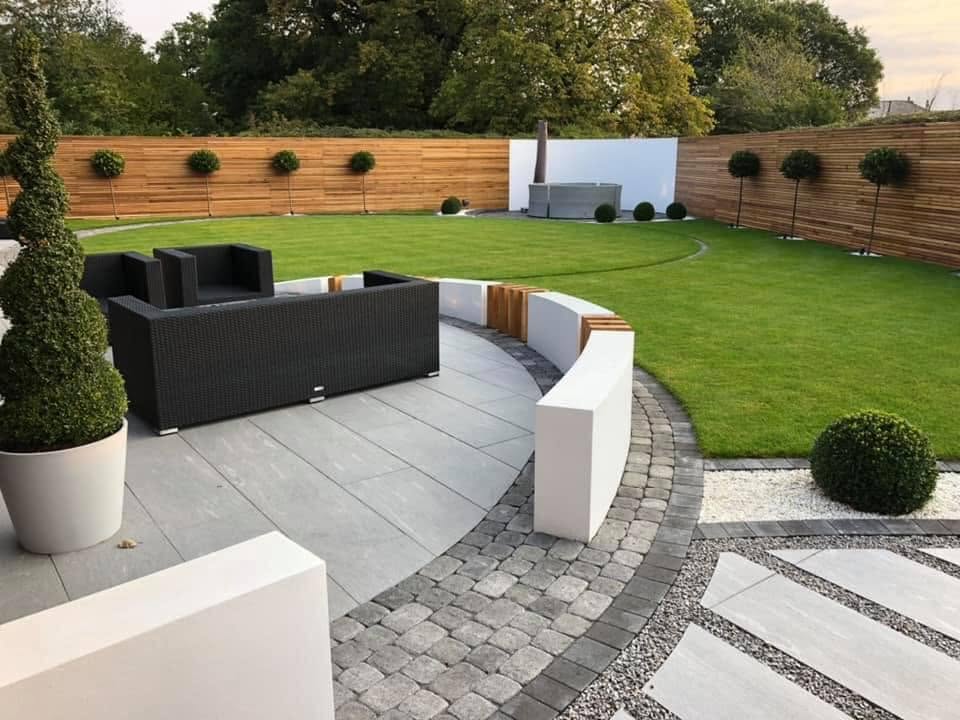
Most patios look their best on the day they are finished. The real test comes a few winters later, after months of rain, falling leaves and nights that dip below freezing. That is usually when homeowners call us about flaking slabs, loose joints or a patio that has started to rock.
If you are weighing up a porcelain vs natural stone patio, it is worth understanding how each one behaves in winter. The good news is that both can last for decades in Essex. The difference is in how they are chosen and how they are laid.
How frost actually damages a patio
Frost does not harm paving on its own. Water does. When water soaks into the surface of a slab, the joints or the bed underneath and then freezes, it expands by around 9 per cent. As Marshalls explains, that expansion causes movement. Repeat the cycle every cold night through a winter and you get:
- surface flaking or spalling on porous stone
- cracked or crumbling pointing
- slabs that work loose and start to rock
- uneven areas where the bedding has been washed out
So the question is not just “which slab is frost proof?” It is “how much water can get into this patio, and where does it go?”
Porcelain: very low absorption, very frost resistant
Outdoor porcelain is fired at very high temperatures, which makes it dense and almost non-porous. Good-quality porcelain paving absorbs very little water, which is why it is so resistant to frost, staining and algae. It also keeps its colour and does not need sealing.
The catch is that porcelain is only as good as its installation. Because it is so dense, mortar does not grip it naturally. Each slab needs a bonding primer on the back and a full bed of mortar underneath. Laid on a few dabs of mortar, porcelain can sound hollow and crack under load, and water can collect in the gaps and freeze.
We regularly use Brett porcelain ranges, including in this garden transformation with an outdoor kitchen and pool.
Natural stone: character that improves with age, if you choose well
Sandstone and limestone bring a warmth and variation that porcelain imitates but cannot fully match. They are also more porous, so they take on water, which makes quality and installation even more important.
Well-sourced stone, cut to a consistent thickness and laid the right way up on a full bed, performs very well in UK winters. Poor-quality or thin stone is where problems start, with laminated stone sometimes flaking in its first hard frost. A breathable sealer can reduce water absorption, but it is not a fix for poor stone or poor laying. We cover the wider pros and cons in our guide to choosing natural stone for your patio.
The installation matters more than the slab
In our experience, most winter damage comes down to what is underneath. A patio that survives frost has:
- A properly compacted sub-base that suits the ground, so nothing settles and lets water sit.
- A full mortar bed with no hidden voids under the slabs.
- The right falls, so rainwater runs off rather than pooling. Our post on why water pools on patios explains this in more detail.
- Well-filled joints that keep water out of the bed.
- Somewhere for the water to go, whether that is a border, a channel drain or a soakaway.
This is also why it pays to use an approved installer. As a Premier Brett Approved contractor, our patios come with a 10-year Brett product guarantee and a 5-year installation guarantee, and every member of our team is employed directly.
Looking after your patio this winter
- Clear wet leaves regularly. They hold moisture and make paving slippery.
- Keep channel drains and gullies free of debris.
- Avoid rock salt on natural stone and pointing. Use a de-icer recommended for your paving instead.
- Use a plastic shovel to clear snow, rather than a metal edge that can chip slabs.
- Check before using a hosepipe or pressure washer. The Environment Agency’s latest drought report confirms that hosepipe bans remain in place for all Essex & Suffolk Water and Anglian Water customers, and in parts of the Affinity Water area.
Can you lay a new patio in winter?
Often, yes. The groundwork, sub-base and much of the build can go ahead in most winter weather. The limit is mortar, which should not be laid in freezing conditions or when a frost is forecast before it has cured. A good contractor plans the laying stages around the forecast rather than rushing to hit a date.
Booking now also means your patio is ready for spring, rather than joining the rush when the weather turns.
Choose with the next ten winters in mind
Whichever side of the porcelain vs natural stone patio debate you land on, both can give you a beautiful patio that lasts. Porcelain is the lower-maintenance choice and the most forgiving in a wet, shaded garden. Natural stone brings more character and suits period and rural homes particularly well. Either way, the build underneath decides how it looks in ten years.
Essex Elite Paving designs and installs porcelain and natural stone patios and complete garden designs across Braintree, Gosfield and the rest of Essex. If you are weighing up materials for a new patio, get in touch or call 0330 043 0387, and we will help you choose a finish that suits your home and copes with whatever winter brings.